This morning I read about new research into xylitol — a sugar substitute widely used in products marketed as sugar-free or "healthier." Data presented at the European Society of Cardiology's 2026 congress, covering more than 17,000 adults across two long-term studies, found that people with the highest blood levels of xylitol had a substantially higher risk of heart attack, stroke and death — up to 57% higher over six years in one cohort. That's not proof of cause and effect. But it raises a broader question.
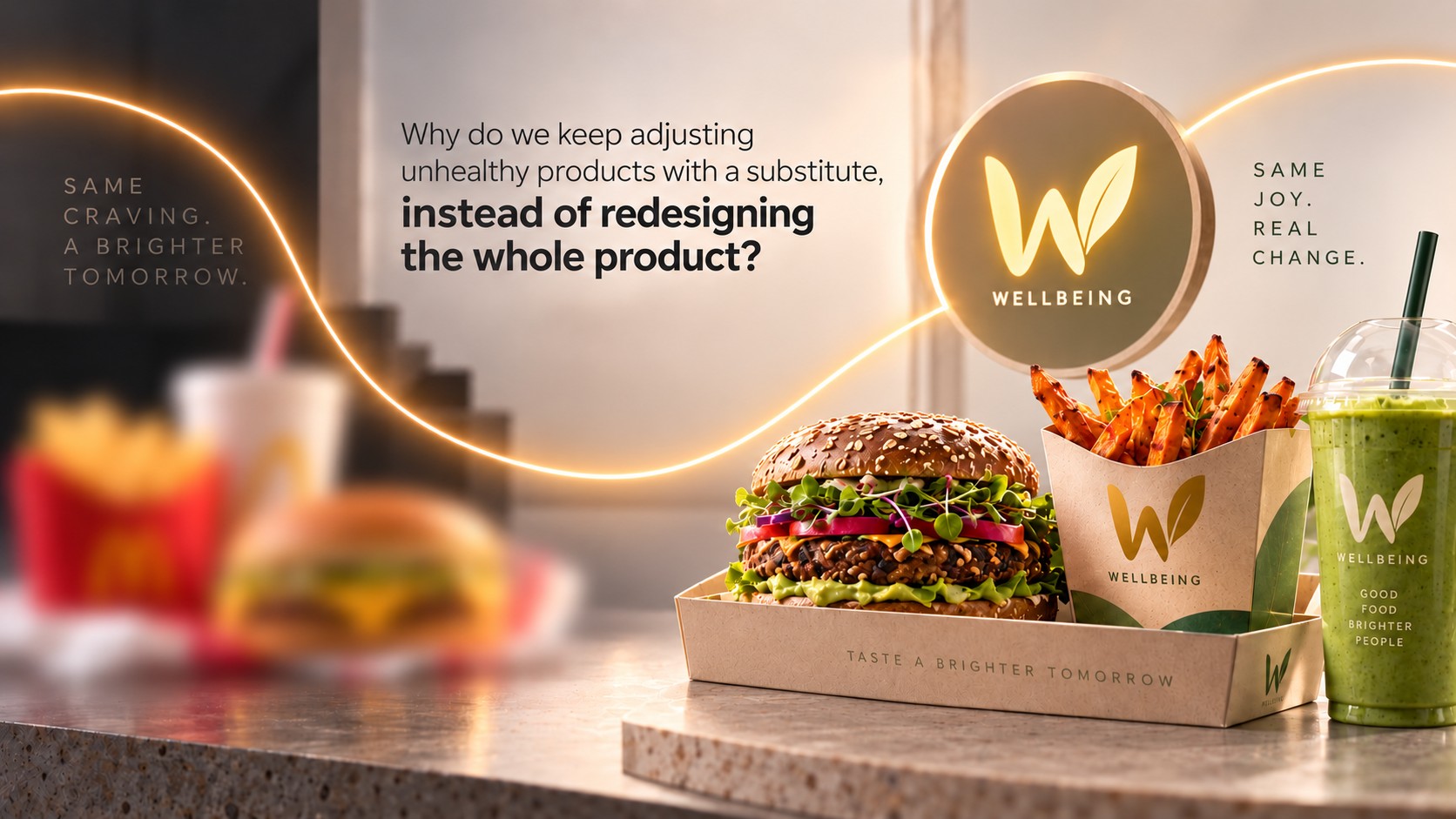
Why do we keep adjusting unhealthy products with a substitute, instead of redesigning the whole product?
From substitute to new standard
Take Coca-Cola Zero. Twenty years ago, sugar-free cola was clearly the alternative — a niche choice on the shelf. Coca-Cola Nederland reported in March 2026 that nearly 60% of its sales volume in the Netherlands is now sugar-free or low-calorie — up from the 50% target it had already reached a few years earlier. Even visually, Zero keeps moving closer to Original.
That's interesting. Not because Zero is automatically the healthy solution, but because it shows how fast an alternative can become the new standard.
And maybe we should think further still. Not just replacing sugar with another sweetener, but slowly getting people used to less sweetness overall. The WHO is already pointing that direction: its 2023 guideline doesn't just discuss which sweetener to use — it advises against relying on non-sugar sweeteners for weight control at all, arguing that reducing the overall sweetness of what we eat matters more than what we swap it for.
That takes more than product development. It takes behavior change.
Imposing "healthy" doesn't work on its own
Schools and workplaces increasingly try to make their canteens healthier. Understandable. But the world outside school and work mostly stays the same — fast food, snacks, delivery apps and deals are everywhere.
Dutch research on school canteens shows the limits of that approach: schools that go strictly healthy sometimes see students simply buy less healthy food from the shop around the corner instead. As one school leader put it, if the canteen only offers healthy items, students go elsewhere for the rest. Gradual change appears to land better than an abrupt switch.
I recognize that from change trajectories. Introducing a change is not the same as landing a transition. People change more easily when the new option feels attractive, logical and familiar — not simply because someone decided it was better for them.
Meanwhile, TikTok decides what tastes good
There's something else going on. Young people — and honestly, me too — see food content scroll by daily on Instagram and TikTok. Sushi cakes, oceans of melted cheese, desserts, shakes, supplements, recipes with bold health claims.
Image usually beats nuance there. Someone claims they lost tens of kilos in four weeks on a particular diet, and within seconds the message is everywhere.
Research on social media influencers popular with children found they promoted hundreds of food products and brands in a single year — the large majority of them less healthy, with fast food and sugary drinks dominating.
More recent research adds a layer to that: influencer marketing aimed at boys skews even further toward unhealthy products than marketing aimed at girls, with a different playbook for each — pricing incentives and urgency for one audience, aesthetics and music for the other. Either way, it's marketing built to feel like content, not an ad.
But that's exactly where an opportunity sits too. If social media can make unhealthy food this appealing, why wouldn't the same mechanisms work to make healthy the new standard?
Why is plant-based still the alternative?
You see the same pattern in fast food. McDonald's, Burger King and KFC now all offer vegetarian and plant-based options. That's progress.
But why does it keep staying its own separate category? Meatless. Veggie. Plant-based. That framing still tells the customer: this is the deviation from normal.
What happens when you flip that? Not meat-free as the alternative, but plant-based as the full, equal starting point — same taste experience, same presentation, same speed, same convenience.
Research on restaurant defaults shows how powerful that shift can be. In one field study, simply making a plant-based option the default on the menu — rather than an opt-in extra — increased its selection dramatically, in some cases from under 10% to over 80%, while meat stayed fully available as a choice.
Nobody is forbidden anything. Only the default changes.
Not every default works the same way, though. A 2025 Stanford University study tried a blunter version of the same idea — simply shrinking the serving spoon for meat in campus dining halls. A modest reduction nudged meat servings down a little; a more drastic one didn't reduce meat at all, and diners noticed and were less satisfied. The lesson isn't that defaults don't work — it's that they still need to feel like a normal, generous choice, not a restriction.
The real innovation might not be in the ingredient
Which is why I think the food industry doesn't just have a health question. It has an innovation and transition question.
We know how to make products appealing. We know how price shapes behavior. We know how packaging works. We know how to speak to different generations. We know how social media accelerates new habits.
The question is why we mostly use all of that knowledge to sell existing products better. Why not to design a new standard instead?
Less sugar in sauces. More fiber and nutrients. Different bread concepts. Fewer refined carbohydrates. More plant-based products. Not positioned as the responsible alternative — but as something people simply want to eat.
That might be the real transition. Not swapping one ingredient at a time. Redesigning product, environment, marketing and behavior together.
Healthy only becomes truly normal once it stops feeling like the healthy alternative.
Valuable background information
Is xylitol bad for your heart?
Data presented at the European Society of Cardiology's 2026 congress, covering more than 17,000 adults in two long-term cohort studies, found that people with the highest blood xylitol levels had a substantially higher risk of major cardiovascular events — up to 57% higher over six years in one cohort, and 18% higher over 30 years in another — with risk rising in step with xylitol levels. That's an association, not proof that xylitol directly causes these events, but it's a strong enough signal that the WHO already advises against relying on non-sugar sweeteners, xylitol included, for weight or health management.
Why does the WHO advise against sugar substitutes?
In its May 2023 guideline, the WHO concluded that non-sugar sweeteners don't offer a long-term weight-management benefit and may be linked to increased risk of type 2 diabetes, cardiovascular disease and mortality. Its underlying recommendation isn't simply choosing a different sweetener — it's reducing the overall sweetness of what we eat, which is a behavioral shift, not a product swap.
Does making healthy food the default actually change what people choose?
Yes — more than most product reformulations do. A 2022 field study on restaurant menus, published in Appetite, found that simply presenting a plant-based dish as the default option, rather than an opt-in alternative, increased its selection dramatically — in one case from roughly 9% to 80% — while every guest could still choose meat. The mechanism isn't restriction, it's the order options are presented in.
Why do healthier school canteens sometimes not change what students actually eat?
Dutch research and reporting on school canteens, including coverage by NOS, shows that strict, abrupt healthy-only policies can backfire: students who don't like the healthier-only offering simply buy snacks and fast food outside school instead, and the canteen sells less without students eating any healthier. Gradual change that keeps food appealing and familiar tends to land better than an imposed overhaul.
Sources
- European Society of Cardiology — Xylitol May Increase the Risk of Cardiovascular Events, ESC Congress 2026 (augustus 2026)
- World Health Organization — WHO Advises Not to Use Non-Sugar Sweeteners for Weight Control in Newly Released Guideline (May 2023)
- Coca-Cola Nederland — Coca-Cola in Nederland Onthult de Innovaties voor 2026 (maart 2026)
- NOS — Scholen Worstelen Met Gezonde Schoolkantines (mei 2022)
- #junkfluenced: The Marketing of Unhealthy Food and Beverages by Social Media Influencers Popular With Children, International Journal of Behavioral Nutrition and Physical Activity (2024)
- Ashley Amson et al. — Beyond the Screen: Exploring the Dynamics of Social Media Influencers, Digital Food Marketing, and Gendered Influences on Adolescent Diets, PLOS Digital Health (2025)
- A Reversal of Defaults: Implementing a Menu-Based Default Nudge to Promote Out-of-Home Consumer Adoption of Plant-Based Meat Alternatives, Appetite (2022)
- A. Voşki et al. — Effect of a Portion-Size Default Nudge on Meat Consumption and Diner Satisfaction, BMC Public Health (2025)
The same principle that makes a menu default work also applies inside your organization: redesigning the whole system beats patching one ingredient at a time. Curious what that looks like for your transition?